Flush Architecture Comparison
Tankless vs Built-In-Tank Smart Toilets: Flushing, Water Pressure, Noise, and Maintenance
Compare tankless and built-in-tank smart toilet flushing by pressure dependence, size, noise, refill behavior, maintenance, and installation conditions.
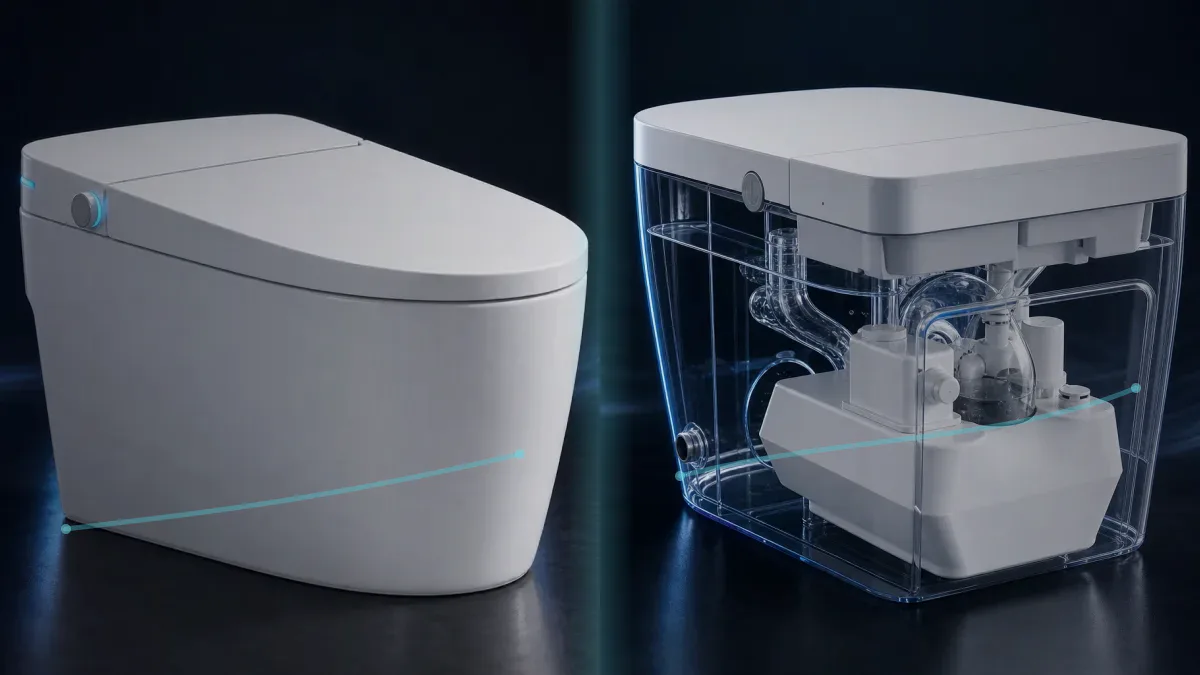
Tankless or built-in tank: the short answer
A tankless smart toilet is often the simpler choice where dynamic water pressure and flow are stable. A built-in-tank smart toilet is often more suitable where supply conditions fluctuate because it can store water between uses and release it during the flush. Neither architecture is automatically cleaner, quieter, more reliable, or more advanced.
This comparison is about the water used to flush the ceramic bowl. It is not a comparison between instant and reservoir heating for bidet wash water. A product can be tankless for flushing but use a small wash-water reservoir, or store flush water while heating wash water on demand.
How the two flushing architectures work
In a tankless flush architecture, the toilet opens a valve and depends mainly on the building supply to move water through the internal waterway and ceramic. The installation is part of the hydraulic system.
In a built-in-tank architecture, the product fills an internal chamber before it is needed. At flush time, stored water is released by gravity, pressure, a pump, or a combination. The building supply still matters for refill, but a short pressure dip during the flush has less direct influence.
Hybrid designs exist, so verify the actual water path rather than relying only on “tankless” or “tank” in a product name.
Side-by-side comparison
| Criterion | Tankless flush | Built-in-tank flush |
|---|---|---|
| Main energy source | Building pressure and available flow | Stored water, sometimes with pump assistance |
| Pressure sensitivity | Usually higher during the flush | Usually lower during the flush; refill still needs water |
| Internal space | No large flush-water chamber | Requires storage volume and related parts |
| Refill behavior | No stored charge to restore | Must refill before the next designed cycle |
| Components | Fewer storage-related parts | Adds chamber, level control and possibly a pump |
| Sound sources | Valve and water path | Valve, refill and possibly pump or vibration |
| Service needs | Filters, valves, waterway | Filters, valves, storage, level control, pump where fitted |
The table describes typical tradeoffs, not guaranteed product performance. A well-engineered example of either architecture can outperform a poorly matched alternative.
Water pressure and flow
Tankless flushing is more exposed to dynamic pressure, flow, pipe size, inlet filters, hoses, elbows, and simultaneous building demand. A good static gauge reading does not guarantee that the required flow remains available when the valve opens.
Built-in storage separates refill from discharge. That can help in low-pressure or variable-pressure sites, but the product still needs enough water and time to refill. A chamber that fills too slowly, misreads the level, leaks, or does not match the flush demand creates a different failure mode.
For uncertain installations, measure the supply under flow and compare it with the exact product manual. See our low-water-pressure smart toilet guide for the measurement process.
Size and appearance
A tankless water path can reduce the space needed for flush-water storage, which may help create a slimmer body. That does not guarantee the complete toilet is smaller; wash heaters, dryers, mechanisms, service access, and ceramic proportions also affect size.
A built-in tank has to fit within the shell or behind the ceramic. Good packaging can hide it, but storage volume, overflow paths, insulation, mounting, and service access cannot be ignored simply to make the exterior thinner.
Noise
Tankless designs can produce valve, pipe, and high-velocity water noise. Pump-assisted tank designs add pump and vibration sound, while refill can continue after the main flush. The room, wall, floor, ceramic, enclosure, mounting, and supply pressure all change what a user hears.
It is therefore unsafe to claim that either category is always quieter. Compare sound-pressure measurements made at the same distance, in the same type of room, and through the full flush-and-refill cycle.
Maintenance and failure modes
Both architectures need clean inlet water and accessible filters. Tankless systems may be affected by valve wear, scale, restrictions, and supply variation. Built-in-tank systems add storage hygiene, water-level detection, seals, overflow behavior, refill control, and pump service where used.
Serviceability matters as much as part count. A slightly more complex system with accessible modules may be easier to maintain than a simple system buried inside a non-serviceable shell.
Which design suits which installation?
Choose based on conditions:
- Stable pressure and flow, limited internal space: a tankless design may be appropriate.
- Low or variable pressure: stored-water flushing may provide more repeatable discharge.
- Frequent consecutive use: check refill time and whether the stored charge recovers fast enough.
- Strict noise expectations: request full-cycle measurements rather than choosing by label.
- Limited local service: prefer clear maintenance access and available replacement modules.
- Power-outage requirement: verify the exact backup flush path; do not infer it from the tank alone.
The final result still depends on the bowl, trapway, water path, valves, pump where used, control timing, and installation. Learn how these parts interact in the smart toilet flushing system guide.
Frequently asked questions
Does tankless mean instant-heated wash water?
Not in this article. “Tankless” here describes flush-water storage. Wash-water heating is a separate design choice.
Is a built-in-tank toilet always better for low pressure?
It often reduces dependence on momentary pressure, but the model still needs suitable refill conditions and a correctly matched pump, waterway, and ceramic.
Which architecture saves more water?
Water use depends on the complete product design and certified or measured flush volume, not the presence of a tank alone.
Which one works during a power outage?
Either architecture may or may not have a mechanical or battery-backed flush. Check the model's documented outage operation.